A scaffolding banner is often well over a hundred square metres and is seen from a long way off. That places different demands on the print files than an ad on a screen or a poster. Here is what you need to know before your visual goes to print.
For every site we send you the exact dimensions and specifications. This guide gives you the overview.
File format
- A vector PDF is the best choice. Text and logo stay sharp at any size.
- Convert fonts to outlines or embed them fully, so nothing shifts at the printer.
- Colours in CMYK, not RGB. If your brand uses specific spot colours, provide the colour values so they can be matched as closely as possible in print.
- Deliver at the scale we specify. Large-format files are often set up at a reduced scale to keep them manageable. We tell you the right scale for your surface.
Resolution
A scaffolding banner is viewed from a distance. The resolution needed at final size is therefore much lower than for a print you hold in your hand. Even so, the source image must be sharp and large enough. A small image from the internet looks grainy and blurred across a hundred square metres. Use original photos at full resolution.
Aspect ratio
Scaffolding surfaces often have unusual proportions, such as very wide or very tall formats. An existing poster design can rarely be used one-to-one. Plan the visual from the start for the specific aspect ratio of the surface.
Safe zones
The banner is fixed to the scaffolding all the way around. Keep text and logo well away from the edges so nothing disappears behind scaffolding tubes, fixings or edges. Depending on the scaffolding, elements such as passageways or structural parts within the surface may also need to be taken into account. We give you the safe zones for every site.
Mesh or solid material
Many scaffolding banners are printed on mesh, a fabric with small openings that lets the wind through. That matters for large surfaces on scaffolding. Mesh affects the design:
- Colours look slightly lighter, because light and background show through the openings.
- Very fine details and thin fonts lose sharpness.
- Strong colours and clear shapes work best.
We agree with you before production which material is used for your surface.
Design that works from a distance
The technical data is one side; the design is the other. What works:
- Few words. People drive past and have only a few seconds.
- Strong contrast between text and background.
- One image rather than several small ones.
- A big logo. Make it bigger than you think.
- Bold typefaces rather than thin or decorative ones.
Test the visual by looking at it small on your phone. If it is legible there, it will be legible on the scaffolding. More in our creative best practices for outdoor advertising.
Think about the site
How is your surface seen? Head-on from a square, at an angle from a main road, or on a corner from two directions? That decides where the key message should go.
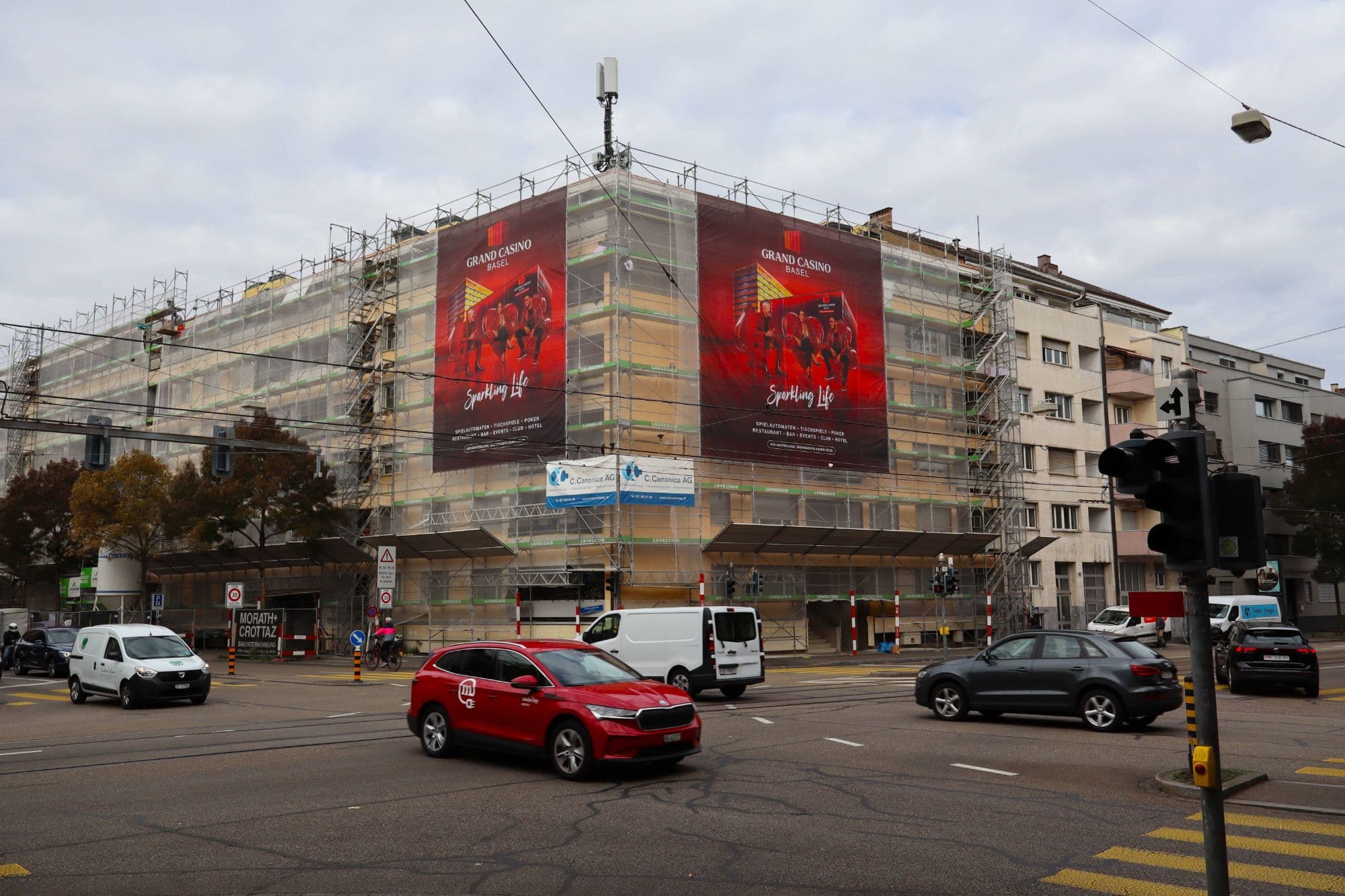
At Riehenring 141 in Basel, for example, the surface is on a corner building. Grand Casino Basel uses two banners there to cover both street faces. At a site like this, it pays to design the visual so it is recognised on both sides. More in the Grand Casino Basel case study.
Approval
Because Hyde Media handles the print, we review the files with you before production. Allow time for corrections in case format or resolution needs adjusting. The earlier you know the specifications, the fewer correction rounds you need. From booking to banner shows when each step is due.
Checklist for your print files
- Vector PDF in the correct aspect ratio
- Set up at the specified scale
- Fonts converted to outlines
- Colours in CMYK, spot colours specified
- Images in sufficient original quality
- Text and logo within the safe zones
- Visual checked for mesh suitability
FAQ
Which file format do I need for a scaffolding banner?
Ideally a vector PDF with fonts converted to outlines and colours in CMYK, at the scale we specify for the surface.
What resolution does a scaffolding banner need?
At final size, much less than a print for close viewing, because the banner is seen from a distance. The source image must still be sharp and available at original size.
What is mesh?
A banner material with small openings that lets the wind through. It is often used on scaffolding. Colours look slightly lighter on it, and fine details less sharp.
Who prints and installs the banner?
Hyde Media handles print, installation, removal and permits. You supply the visual.
Want the specifications for a particular site? Contact us. See the available surfaces under scaffolding advertising.